
Products

Problems
we solve

We can help your business

Request a Free Demo / trial

Insights

Insights | From a different perspective
16 February, 2021

Are Test Budgets Falling? WQR Thinks They Are

Are Test Budgets Falling? WQR Thinks They Are

According to our friends at the World Quality Report (WQR), test budgets are falling. At least as a percentage of overall IT spend. But are they really? I’m not convinced.

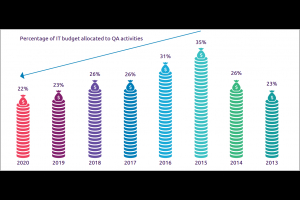
Specifically, the WQR 2021 claims that over the last 5 years test budgets have fallen from 35% to 22%, as a percentage of overall IT budgets.

This is a 5-year period that has seen continued growth of tech, an explosion in online devices and activity – even your local takeaway has an integrated technology solution.

The WQR Figures Show A Significant Fall in Test Spend

If you look at the WQR numbers in a bit more detail, a relative decrease of 13% is even more significant than it initially appears.

A 13% fall in relative spend represents a 37% fall in actual testing spend

Assuming IT budgets have remained relatively static that is, and here’s why:

Let’s say your overall annual project budget is £1m

  • In 2015, testing was 35% of your £1m budget: 35% of £1m = £350k
  • In 2020, testing was 22% of your £1m budget: 22% of £1m = £220k
  • Over 5 years, testing spend has fallen by £130k (350k – 220k)
  • Therefore, testing spend has fallen by 37% (130k/350k) 

According to the WQR then, there has been a 37% fall in actual testing spend. 

These are startling figures and I just don’t buy it. Does this massive decrease in test spend ring true for you?

People Are The Biggest Cost

We know that in all IT projects, people are the biggest cost. Have IT teams grown massively in the last 5 years? And without any additional testers?  I have not seen any evidence of this, have you?

Alternatively, are there fewer testing jobs than there were? Are there loads of unemployed testers running around looking for work? I don’t think there are.

The WQR Numbers Do Not Represent Normal Companies

To understand these numbers a bit more I looked at the sample population – just who are being interviewed for this document? 

2 interesting facts instantly jumped out me…

  1. The WQR only interviewed 155 people from the UK. Even if they were all from different companies, that’s a fraction of the total UK market. There are over 300 banks in the UK alone, never mind other sectors.
  2. The WQR only samples companies with 1,000+ employees. In fact, 75% of those interviewed came from companies with 5,000+ employees. 41% came from companies with 10,000+ employees!

Perhaps the stated decease in test spend is realistic for these groups, but I seriously doubt it. And it’s certainly not representative of the companies I speak to.

Tech Has Never Been More Important

The UK is in the grip of the biggest economic recession in 300+ years, but even with this pressure we’re seeing growth in the software space – and lots of it in testing. Even non-IT folk like Fatima the ballerina are being persuaded to get tech jobs.

It’s also reasonable to state that IT has never been more important to brand reputation – nowadays a crash or system outage is a major news story. 

Surely then, the percentage spend on testing should be increasing. Decreasing testing spend now could be dangerous.

Reducing Test Spend Could be Dangerous! 

The WQR numbers just don’t stack up, not for most of us. Worse than that, they’re actually dangerous. They’re encouraging companies to spend less on testing. Is this sensible in a world where IT complexity, rate of change and the impact of software failure are all increasing?

If a stakeholder were to read the WQR, they might reasonably come away thinking they’re doing something wrong. They might use this as a catalyst to reduce spend on testing – as if it’s not squeezed enough anyway.

What Do You Think?

Have you seen a significant fall in the number of testers, or test spending? I’m interested to know what you’ve experienced.

It would be great to know what you see in your organisation. Do you share my concern, or have I got this wrong?

Get in touch directly, or post a comment below

Do you share my concern, or have I got this wrong?

Stephen Davis
by Stephen Davis

Stephen Davis is the founder of Calleo Software, a OpenText (formerly Micro Focus) Gold Partner. His passion is to help test professionals improve the efficiency and effectiveness of software testing.

To view Stephen's LinkedIn profile and connect 

Stephen Davis LinkedIn profile

16th February 2021
2025 top testing articles

2025 Roundup: Check Out The Top 5 Testing Times Articles

Thanks to your support, 2025 was another excellent year for Testing Times and our 10,000+ subscribers. We explored a wide range of software testing topics, including test automation, performance testing, Jira fatigue, tester authority, and more. Below is a quick look at the five newsletters with the most reactions this year, and why they resonated so strongly.

Is WFH worth the risk

Remote Testing: Is Working From Home Worth The Risk?

Increasingly, organisations expect remote and hybrid testers to use borrowed tool licences, unstable VPNs, and software never designed to leave the office. That creates significant compliance and security risks that can turn into serious long‑term problems. It’s not the testers per se, but remote execution over on‑prem licences is a software audit waiting to happen. Read on to learn why a compliance nightmare isn’t the only reason your test setup might not be fit for distributed and home‑working team members.

Effortless automation

Solved: 4 Common Test Automation Headaches

Software teams know the story all too well: automation promises speed and reliability, but reality often brings fragile scripts, phantom failures, and endless rework. In the end, the technology intended to accelerate releases ends up bogging things down. Or at least, that’s how things used to be… Today’s AI-powered functional

Test the Untestable

Test the Untestable: Unlock Savings & Accelerate Your Project

Testers have long been asked to test earlier, faster, and more often. In truth, however, when critical APIs, integrations, or microservices aren’t ready, testing gets stuck. We’ve all been there, raring to go, like greyhounds in the slips…  but with nothing to test, and increasingly concerned about the impending last-minute panic.

The Test Tools You Need

Testers: Will We Finally Get The Tools We Need?

During the 2008 credit crunch, companies slashed technical investment. The mantra “do more with less” stuck—and 17 years later, testers are still paying the price as demands, complexity, and expectations have soared. It’s no coincidence that we’re witnessing an increasing number of high-profile software failures and cyber attacks. Yet, there’s still little willingness to invest in the right test tools and training.

Test Automation Fails Smaller Teams

Why Test Automation Fails for Smaller Teams

Many small software teams turn to test automation, expecting substantial time and cost savings. However, they often fail to achieve any of these goals; instead of seeing a return on investment, they end up spending more effort and cost fixing their automation packs. This failure can leave lasting scars, deterring people from embracing automation and realising its many benefits…

breaking up with legacy tools

When to Move on From Legacy Test Tools

I often speak to people who want to abandon legacy test tools and transition to shiny new solutions. They cite several reasons for the switch, many of which are valid, while others need greater consideration to avoid a negative or costly outcome. On the other hand, I also speak to people who are reluctant to ever change tools, even though they’d see incredible benefits.

Shift Left

Shift Left Testing: 4 Myths and Why They Matter

Shift-left testing has become one of the most talked-about software development ideas. It sounds deceptively simple: test earlier in the process to avoid late surprises. But while the phrase is repeated at countless conferences and stand-ups, it is often misunderstood, misapplied, or reduced to a box-ticking activity (like many other testing initiatives).

Is speed destroying quality

Are Faster Releases Destroying Software Quality?

The relentless obsession with ever-faster software delivery puts increased pressure on projects and teams, forcing them to adopt new processes and behaviours, but at what cost? The need for speed has transformed release frequency into a core metric, but is this relentless pursuit of speed undermining quality?

AI in software testing

AI in Software Testing: Just Another Fad?

AI is everywhere. The software testing industry is flooded with buzzword-heavy solutions, and you’d be hard pressed to find a vendor that hasn’t marked at least one of their tools as AI-powered. But is AI another in a long list of cautionary tales, or does it genuinely herald a new era?

Insights

Search

Related Articles

To get other software testing insights, like this, direct to you inbox join the Calleo mailing list.

You can, of course, unsubscribe 

at any time!

By signing up you consent to receiving regular emails from Calleo with updates, tips and ideas on software testing along with the occasional promotion for software testing products. You can, of course, unsubscribe at any time. Click here for the privacy policy.

Sign up to receive the latest, Software Testing Insights, news and to join the Calleo mailing list.

You can, of course, unsubscribe at any time!

By signing up you consent to receiving regular emails from Calleo with updates, tips and ideas on software testing along with the occasional promotion for software testing products. You can, of course, unsubscribe at any time. Click here for the privacy policy.