

Test data has always been one of the slowest, least glamorous parts of software testing. It is rarely strategic work, but it holds everything up. No matter how good your test plan is, weak data can make the whole exercise unreliable.
Test teams have long used functional test automation and performance testing tools to generate test data. Often, including steps within an automation test to generate the specific data for that test. I still love this approach, by the way.
Unfortunately, not every team has this sort of tooling in place, but they do have access to chatbots. Increasingly, people turn to AI for help with every mundane task, including test data generation.
AI Can Be Useful for Test Data
AI can help generate sample records, reshape existing data, create variations, and reduce some of the manual effort around preparing test inputs. But it needs careful handling.
Test data is one of those areas where closeis not always enough. AI-generated data can appear realistic while quietly violating business rules, overlooking important edge cases, or creating a false sense of coverage. It’s promised speed relies on a trust which is often assumed but rarely earned.
Used well, AI can support test data prep. Used badly, it can produce convincing nonsense at scale.
What You Should Watch Out For
The biggest risk with AI for test data is false confidence.
If a dataset looks plausible, teams may assume it is good enough. That is where problems begin. You can end up testing with records that do not reflect real workflows, real validation rules, real customer behaviour, or real failure conditions. AI can support test data creation, but it still needs guardrails. Data must be validated against business rules, sensitive fields must be protected, and the final output still needs human judgement.
Five Reasons to Use AI for Test Data
1. It can reduce a common testing bottleneck
Creating and maintaining test data is often slow, manual, and thankless. AI can dramatically reduce the time it takes to generate usable datasets, helping you start testing sooner and refresh data more often.
2. It can make variation easier
You do not have the time to handcraft large numbers of variations. AI makes it easier to generate diverse records, combinations, and scenarios that would otherwise be skipped for effort alone.
3. It cuts down the dullest work
A lot of test data preparation is repetitive admin disguised as testing. AI can take care of that grind, freeing testers to focus on risk, logic, and application behaviour.
4. It helps you scale without drama
When test cycles suddenly expand, AI can generate data volumes that would be painful to create by hand. That is especially useful when performance, regression, or repeated execution demands lots of fresh records fast.
5. It reduces dependence on production data
Often, you cannot safely use real production data, or only have access to heavily limited versions of it. AI offers a way to generate realistic substitutes without relying so heavily on live customer information.
Five Things to Look Out For
1. Plausible data is not the same as valid data
This is the big one. AI can produce data that appears convincing but fails to reflect real business logic, field dependencies, workflow rules, or exception handling. It may look right at a glance, while being completely wrong for the test.
2. It can industrialise bad practice
If you already have weak controls around test data, AI can make the problem bigger and faster. Poor assumptions, bad masking, or lazy reuse of sensitive information become more dangerous when built at scale, without guardrails, and fed to automation tools.
3. It does not know which edge cases matter most
AI can generate variety, but variety is not the same as relevance. It may create lots of unusual records while still missing the handful of edge cases that actually break the system.
4. It encourages lazy trust
The easier the data is to generate, the easier it becomes to stop questioning it. That is where you get into trouble. AI can create the illusion that test data is “sorted” when it has only been produced, not properly validated.
5. It still needs ownership and governance
AI does not remove the need for rules, review, and accountability. Someone still needs to decide what good test data looks like, how it should be checked, and where the limits are. Without that, AI is just a faster way to make mistakes.
Additional AI Considerations
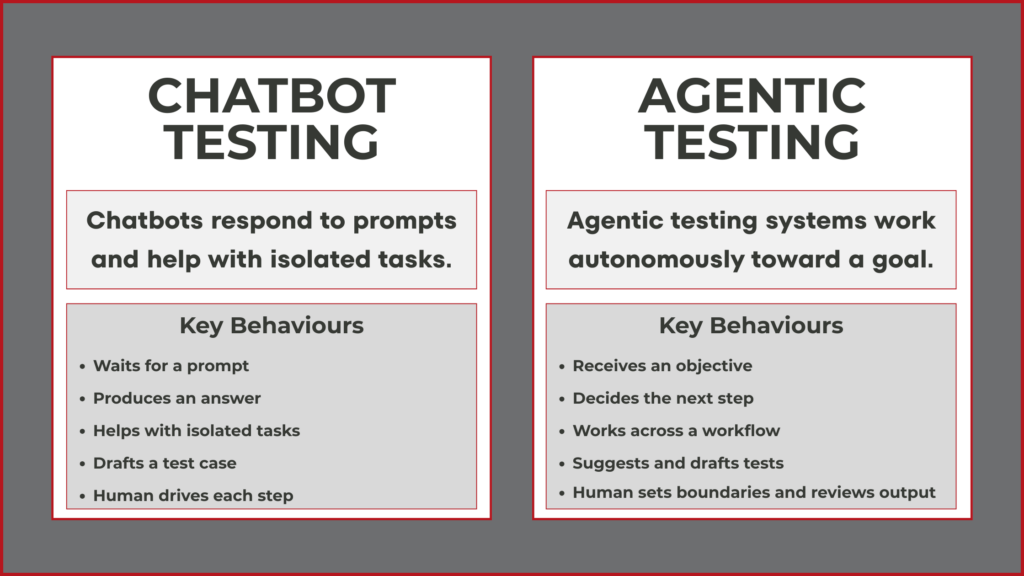
AI-generated test data is only one part of the testing picture.
The wider question is how AI is being used across test design, automation, execution, and maintenance. Test data should not sit outside that process. It should be part of a controlled workflow in which teams understand what has been generated, why it was generated, how it will be used, and how it will be checked.
That is where testing tools can play an important role. For example:
- OpenText Functional Testing helps you build and run data-driven tests while leveraging AI-powered capabilities such as object recognition, OCR, and text matching to reduce maintenance effort.
- DevOps Aviator accelerates test design and automation by generating test ideas, creating test steps, and converting videos to manual tests and automation assets.
These tools reflect the direction testing is moving in: more automation, more AI support, and more need for control.
AI can help teams move faster, but test data still needs structure, validation, and ownership. The stronger the testing workflow around it, the safer and more useful AI becomes.