
Agentic testing is one of those phrases that has started appearing everywhere. There’s an underlying assumption that everyone already knows what agentic workflows are, but many don’t.
So what does it mean? And more importantly, does it actually matter right now?
At a high level, agentic testing is about autonomous or semi-autonomous test tools that work from goals, make decisions, interact with applications, and support testers throughout the software delivery lifecycle.
For example, an agentic testing capability might read the requirement, compare it with existing test coverage, suggest missing cases, generate draft tests, link them back to the requirement, and help prioritise which tests to run based on recent changes.
What Does Agentic Mean?
An agent is something that can act. In technology, an AI agent is usually understood as a system that can receive a goal, assess its environment, make decisions, use tools, and take action within defined limits.
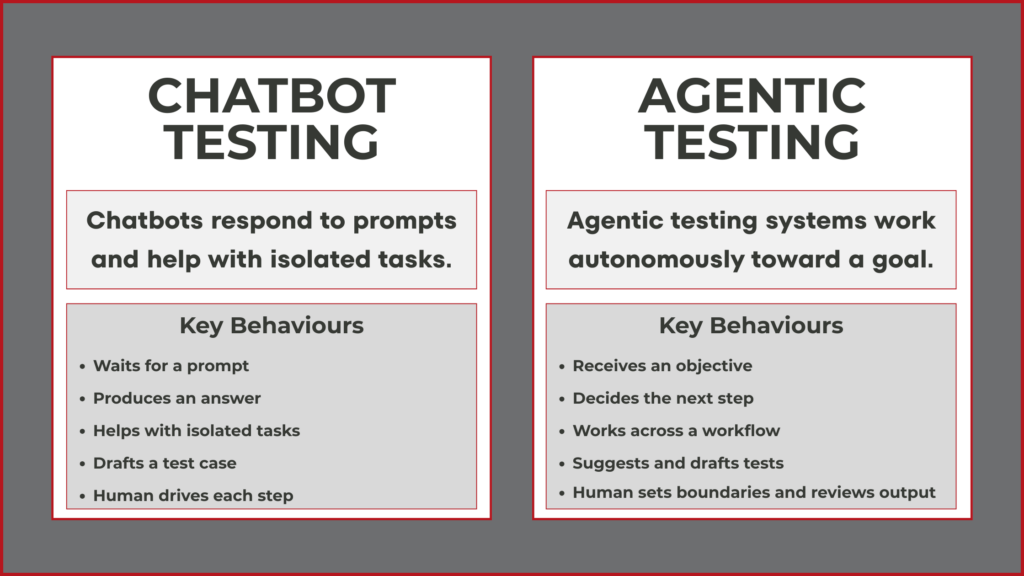
Compare that to a chatbot. It can help you write a test case, summarise a defect, suggest edge cases, or generate sample data. That can be useful, but the chatbot mostly responds to prompts. It is waiting for you to ask, and then giving you something back.
An agentic system can work toward an objective by deciding which step to take next, within defined boundaries. In a testing context, objectives might include things like:
- “Check whether this user can complete the onboarding journey.”
- “Create tests from this requirement.”
- “Identify which regression tests are most relevant to this change.”
- “Investigate why this test failed.”
- Look for coverage gaps across these requirements, defects and releases.”
The important difference is that the system is making decisions about what to do next.
What Is Agentic Testing?
Agentic testing means using AI agents to support, guide, or perform parts of the software testing process. That does not mean the agent has unlimited freedom.
It’s also important to keep in mind that agentic testing is a direction of travel, rather than a fixed category.
Testing tools are becoming more goal-driven, context-aware and capable of taking action across connected workflows.
The practical version of agentic testing is controlled, governed, and bounded. The agent operates within a tool, a project, a permission model, a test environment, and an agreed workflow. It may recommend actions, generate assets, execute certain tasks, or flag risks, but it still needs human oversight.
This is especially important in regulated or complex environments, where test evidence, auditability, security, and traceability matter as much as speed.
How Is This Different From Using a Chatbot?
Many teams are already using AI in testing. A tester might ask a chatbot to draft a test case, explain an error message, generate synthetic data, write a script stub, or suggest negative scenarios.
Agentic testing is more ambitious and introduces a different level of responsibility.
Once AI begins operating within the testing workflow, teams need to consider permissions, data access, review steps, traceability, and accountability.
Why Does Agentic Testing Matter?
Agentic testing is important because software delivery is becoming too fast and too complex for traditional testing models to scale cleanly.
- Applications change constantly.
- Release cycles are shorter.
- Development teams are using AI to produce and modify code faster.
- Enterprise systems often span web applications, APIs, packaged software, mobile devices, cloud services, legacy platforms and tightly controlled internal environments.
Agentic testing can help test teams move from manual interpretation and repetitive maintenance toward higher-value judgement. Instead of spending so much time creating, updating, selecting and investigating tests, testers can spend more time deciding what quality means, where the real risk sits, and which areas need deeper human attention.
How Far Will Agentic Testing Go?
The shift looks increasingly likely, although full autonomy will arrive more slowly than the marketing suggests.
Testing tools are already becoming more intelligent.
AI-assisted test creation, self-healing automation, visual validation, defect analysis, risk-based recommendations and intelligent orchestration are already moving into mainstream platforms.
There is a big difference between using an AI agent to create a test and letting it take responsibility for release quality. Most enterprise teams will be comfortable with the first long before they are comfortable with the second, but over time, this model is likely to become more common.
When Will This Affect Enterprise Testers?
Many testers are already seeing the effects. Not necessarily under the label “agentic testing”, and not always in a dramatic way. The change is showing up in smaller, practical features:
- Tools that generate tests from requirements.
- Automation that adapts when object properties change.
- Systems that recommend which tests to run.
- Analytics that identify risk areas.
- Assistants that summarise failures and suggest likely causes.
- Platforms that connect requirements, defects, pipelines and test evidence.
These are the early building blocks of a gradual change.
Testers need to understand the concepts, recognise where the technology is appearing, and identify which parts of their own workflow could safely benefit from it. However, they don’t need to worry that they’ll wake up one morning to find themselves obsolete.
Testers will still need domain knowledge, risk awareness, critical thinking, exploratory skill and an understanding of how systems actually behave. In fact, those skills may become more important. If AI can generate more test assets, suggest more actions and process more information, human testers still need to decide whether those outputs are useful, relevant and safe.
Where Agentic Testing Needs Control
The more AI moves inside the testing workflow, the more important control becomes. Teams need to know what the agent can access, what it can change, what evidence it creates, and where human review is required.
Agentic testing can inherit the same problems as any other testing process: unclear requirements, weak data, unstable environments, poor traceability and badly defined risk.
AI can accelerate useful work, but it can also accelerate confusion if the workflow around it is not well governed.
What Should Test Teams Do Now?
The first step is to understand where agentic capabilities could help your existing testing process.
Look for areas where your team spends too much time on repetitive interpretation, maintenance, selection or investigation. Then ask whether AI could assist within a controlled workflow.
Good starting points include:
- Turning requirements into draft tests.
- Identifying gaps in coverage.
- Improving regression selection.
- Supporting test maintenance.
- Summarising failed runs.
- Connecting defects, changes and test evidence.
The best use cases are usually narrow, measurable and easy to review.
In Summary
AI is moving from a side tool that testers consult occasionally to an embedded capability inside the testing workflow. It can help teams interpret, decide, act and adapt, provided it operates within the right boundaries.
Agentic testing will not remove the need for testers. It will change where testers spend their time.
The future of enterprise testing will be skilled testers working with intelligent tools that can handle more of the repetitive work, surface more useful signals, and help teams focus on the areas of greatest business risk.
If you are exploring how AI could support your testing process without compromising quality, governance or traceability, Calleo can help you identify practical, controlled starting points.